

How QSR Brands Adapt Menus for Different Markets and Cities
Menu localization isn't just a new item on the board. Here's the sourcing, kitchen, and training changes that actually happen behind a regional QSR menu item.
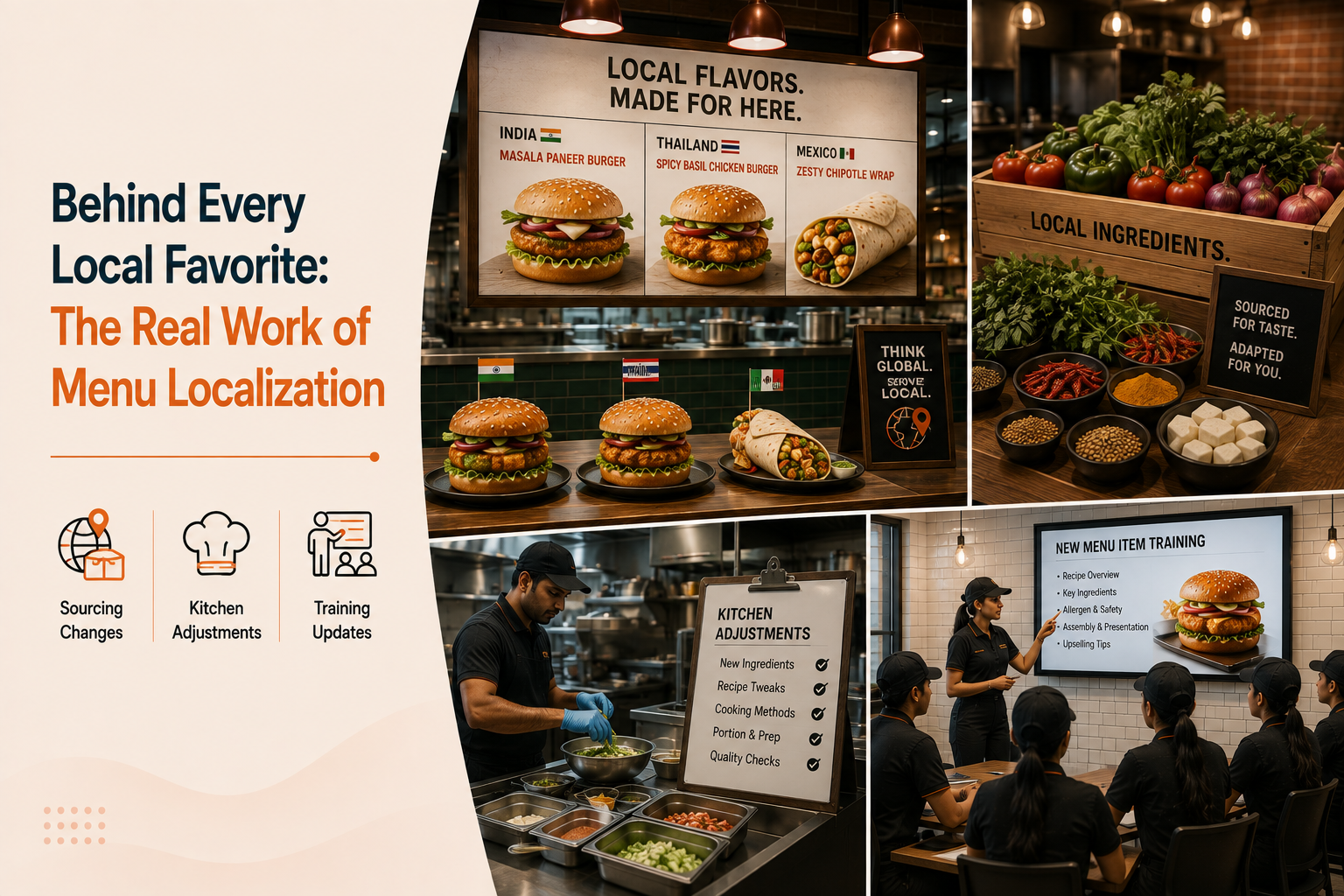
Our earlier breakdown of business model, ownership, and menu category touched on menu localization with a few familiar examples, the McSpicy Paneer Burger, the Hyderabadi Biryani Bucket, a Chettinad Paneer Pizza. These make good headlines, but they're the visible tip of a much larger operational process.
This post goes past the examples into what actually happens behind a regional menu item, in sourcing, in the kitchen, and in staff training, every time a brand decides to localize.
Why Menu Localization Is an Operational Decision, Not Just a Marketing One
A new regional item isn't a menu-board update.
It touches:
- Sourcing and vendor relationships
- Kitchen equipment and prep methods
- Staff training and documentation
- Food safety protocols
Treating localization as a marketing exercise alone is exactly where the operational strain shows up later, usually after the item has already launched.
Not Every Menu Item Can Flex the Same Way
Not all menu items carry the same tolerance for variation, and understanding this distinction shapes how aggressively a brand should localize.
Mainstream, near-universal items
Dishes like butter chicken-style gravies appear on nearly every QSR and casual dining menu in India. Customers know them well enough to notice immediately if something's off. At this tier, consistency isn't one priority among several, it's the entire point.
Next-wave, hyper-regional flavors
This is where real differentiation happens, specific regional spice profiles and flavor identities that go beyond generic categorization. A distinct regional chilli character or a coconut-and-spice profile tied to a specific region are genuinely different from a generalized "spicy" or "mild" label.
Knowing which tier a menu item falls into determines whether a brand should standardize it tightly or give it room to experiment.
What Actually Changes in the Supply Chain
Ingredient substitution
Cost and availability often drive substitution decisions as much as taste does. Replacing cheese and beef with paneer and chicken, for example, isn't only about local preference, it's also meaningfully cheaper, often by 30 to 40 percent, while still meeting regional taste expectations.
Vendor certification
Sourcing region-specific spices and ingredients isn't a one-time decision. It requires ongoing vendor certification and management, ensuring quality and consistency hold up across every order, not just the first one.
Sourcing stability as the real constraint
A recipe that performs well in a test kitchen but can't be reliably supplied at scale isn't ready for rollout. Stable, repeatable sourcing is a strategic requirement for localization, not a procurement afterthought.
What Changes in the Kitchen Itself
Equipment modifications
Regional recipes often demand different kitchen handling. Indian gravies, for instance, tend to carry higher moisture content than a brand's standard menu items, which can require equipment adjustments to prep and hold correctly at scale.
From one-off recipes to standardized systems
The real shift happening across the industry is a move from individual regional recipes toward systemized bases, pastes, and concentrates that hold a flavor signature and survive real kitchen conditions across every location. This is what makes a regional flavor reproducible by any trained team member, rather than dependent on one especially skilled cook.
Why this becomes an SOP issue
A new regional item effectively becomes a new SOP, not a footnote added to an existing one. It needs its own prep steps, its own food safety considerations, and its own training material, the same way any other operational process would.
How Brands Test Before Rolling Out Regionally
R&D and test kitchens
Larger QSR brands increasingly invest in dedicated food innovation teams and test kitchens, treating new menu development as a structured process rather than an occasional experiment.
Piloting through cloud kitchens and virtual brands
Cloud kitchens and virtual brand formats give brands a lower-risk way to test a new recipe in a limited market before committing to a full rollout, validating both customer demand and kitchen feasibility at the same time.
Real payoff from getting it right
This process pays off in measurable ways. Localized menu items have driven meaningful same-store sales increases in their pilot regions for several major QSR brands, evidence that the sourcing and kitchen work behind localization translates into real commercial results, not just goodwill.
The Economics Behind Localization
Localization isn't purely a customer-experience investment, it has real, direct economics behind it.
- Regional ingredient substitution can meaningfully lower ingredient costs
- Some localized menu items have delivered noticeably higher gross margins than standard menu items
- This makes localization a genuine business lever, not just a way to seem locally relevant
Why the Localization Cycle Is Getting Faster
Social media has compressed how quickly a new item needs to reach the market. A large share of Gen Z customers now discover new QSR items directly through social media, with purchase decisions increasingly happening within a day of seeing a trending post.
This shortens the runway between test kitchen and store rollout considerably, and raises the bar for how fast sourcing, kitchen prep, and staff training can actually keep pace with a much faster menu development cycle than QSR brands worked with even a few years ago.
What This Means for Store-Level Operations
Every new regional item that reaches a store shelf needs:
- Updated SOPs covering the new prep process
- Retrained staff, not just a note passed along informally, our look at what happens to training content in the days after a new hire learns it is a useful starting point for why this needs more than a one-time briefing
- Updated food safety and handling documentation, particularly where moisture content, spice handling, or new ingredients are involved
- Staffing adjustments where a new item genuinely changes prep time or shift workload, a longer-cook regional item, for example, can shift how many hands are needed on a given shift compared to the standard menu
Our complete guide to Standard Operating Procedures for multi-location businesses and our breakdown of the checklist types every store needs cover what this documentation actually needs to include. Retraining staff on a new prep process also has to sit inside a shift plan that already exists, without adjusting for the extra prep time a new item genuinely needs, stores tend to launch understaffed on exactly the hours the new item is meant to perform best. This is where structured workforce scheduling makes the difference between a smooth rollout and a launch week spent quietly playing catch-up on the floor.
This is really the core point: menus change constantly, city to city, brand to brand, market to market. What doesn't change is the operational system underneath, the SOPs, training, and audits that make sure a new item performs the same way whether it's the first location serving it or the fiftieth.
Book a personalized demo to see how NymbleUp helps multi-location QSR brands keep SOPs, training, and audits up to date as menus evolve across markets.
FAQ
Why do QSR brands localize their menus for different markets? Localization helps brands connect with regional taste preferences, and it often makes commercial sense too, localized items have driven measurable sales increases and, in some cases, better margins than standard menu items.
What actually changes when a QSR brand adds a regional menu item? Far more than the menu itself. Sourcing and vendor relationships, kitchen equipment and prep methods, staff training, and food safety documentation all typically need to be updated to support a new regional item properly.
How do QSR brands test new regional menu items before a full rollout? Many brands use dedicated R&D or test kitchens, and increasingly pilot new items through cloud kitchens or virtual brands in a limited market before committing to a wider rollout.
Does menu localization affect food safety and training requirements? Yes. A new regional item, particularly one involving different moisture content, spice handling, or unfamiliar ingredients, typically needs its own updated prep steps, food safety considerations, and staff training, the same way any new SOP would.
Does a new regional menu item affect staffing and scheduling? It can. Items with longer or more complex prep times often need more hands on a shift than the standard menu requires, and without adjusting the schedule ahead of a rollout, stores risk being understaffed right when demand for the new item is highest.

How Video Analytics Reveals Who's Actually Walking Into Your Store
Discover how AI video analytics helps retailers gain real time demographic insights, understand visitor patterns, personalise offers, optimi…
Read more
What Makes One QSR Chain Different From Another?
From cloud kitchens to franchise ownership to menu category, a breakdown of what actually differentiates one QSR chain from another, and wha…
Read more
What Happens After a Customer Leaves the Store?
A customer's shopping journey may end at checkout, but retail operations continue long after they leave. Discover how leading retailers turn…
Read more