

Standard Operating Procedures (SOPs): A Complete Guide for Multi-Location Businesses
Learn what SOPs are, why they matter for multi-location retail, QSR, and hospitality brands, and how to create, roll out, and maintain them across every outlet.
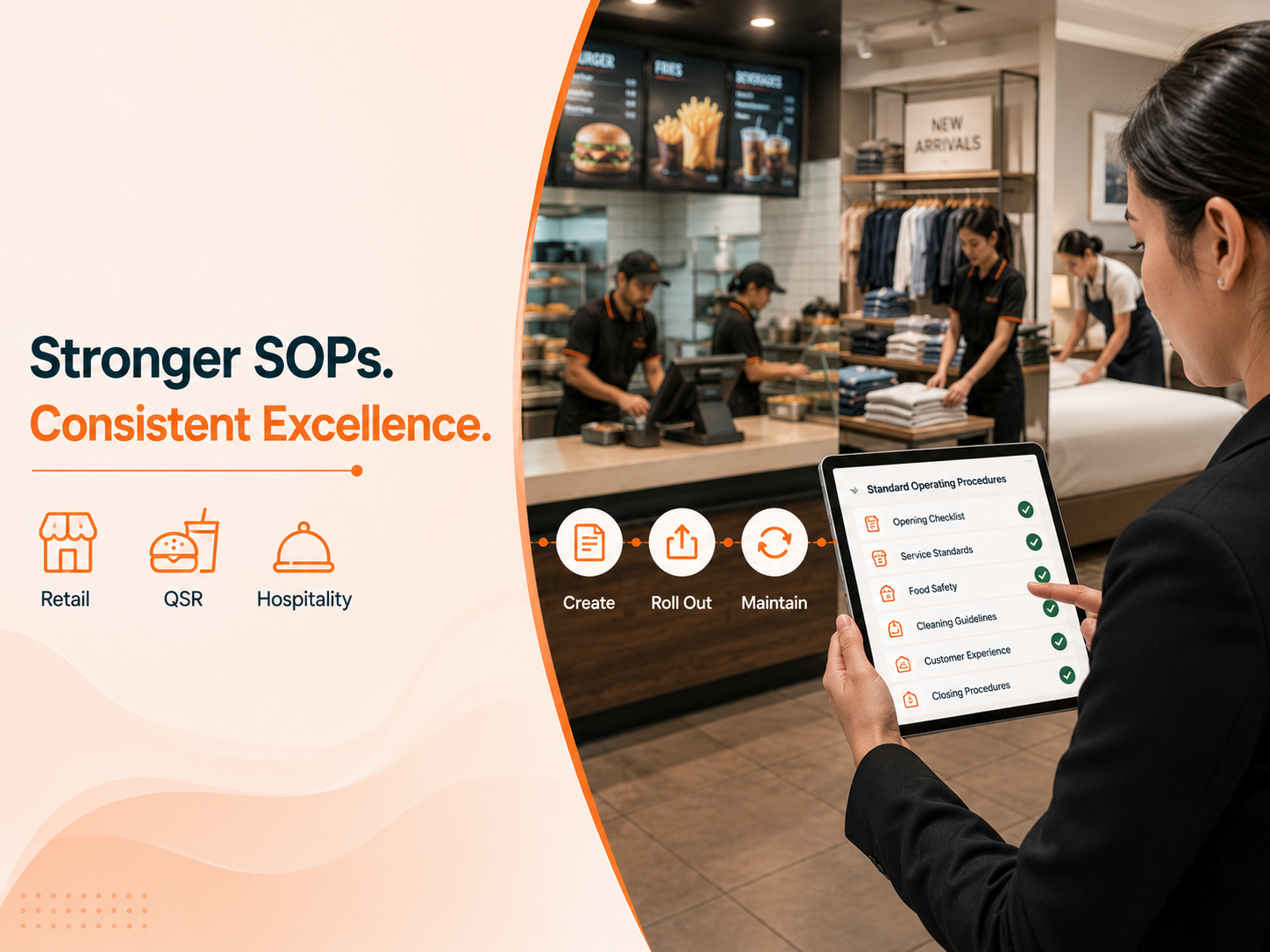
Every business develops its own way of doing things. The problem starts when that "way of doing things" only exists in a few people's heads. One store's opening routine looks nothing like another's. A customer complaint gets handled well by one manager and poorly by the next. As a business grows past a single location, informal knowledge stops being enough.
Standard Operating Procedures (SOPs) solve this by turning "how we do things here" into a documented, repeatable process. This guide covers what SOPs are, why they matter more as a business scales across locations, how to build ones that actually get followed, and how they apply differently across industries like QSR, retail, grocery, and hospitality.
What Is a Standard Operating Procedure?
A Standard Operating Procedure is a documented, step-by-step set of instructions for how a specific task should be carried out. It answers the practical question: what exactly do I do, in what order, to complete this task correctly?
An SOP is different from a policy. A policy defines the rule or the reason behind it, for example, a cash-handling policy might state that all cash drawers must be reconciled at the end of every shift. The SOP is what tells an employee exactly how to do that reconciliation, step by step, including what to record and who to report discrepancies to.
Put simply: policies explain the why, SOPs explain the how.
Why SOPs Matter More at Multi-Location Scale
In a single-location business, informal knowledge can work well enough. The owner or manager is present, questions get answered on the spot, and inconsistencies get caught quickly.
That approach breaks down once a business expands past a handful of outlets. Different managers interpret the same task differently. New hires learn whatever version of a process the person training them happens to know. Quality and customer experience start to vary from one location to the next, not because staff aren't capable, but because there's no shared standard to work from.
Without documented SOPs, multi-location businesses tend to run into the same set of problems:
- Inconsistent customer experience across outlets
- Slower, less structured training for new employees
- Increased compliance and safety risk
- Difficulty diagnosing why one location underperforms another
- Heavy reliance on a small number of experienced staff
SOPs fix this by giving every location the same playbook, so consistency doesn't depend on who happens to be working that shift.
Types of SOPs Every Multi-Location Business Needs
Most multi-location businesses need SOPs across several core areas, not just the obvious operational tasks.
Operational SOPs Day-to-day processes like opening and closing routines, service steps, and cleaning schedules. These are usually the first SOPs a business writes, since they're the most repeated tasks.
Safety and Compliance SOPs Food safety procedures, workplace safety protocols, and emergency response steps. These carry the highest risk if skipped or done inconsistently, and they're often what regulators or auditors check first.
Customer Service SOPs How to handle complaints, refunds, disputes, or situations that could affect the brand's reputation. Consistency here directly shapes how customers experience the brand across different locations.
HR and People SOPs Onboarding steps, shift handovers, and how performance issues are handled. These SOPs matter as much for internal consistency as customer-facing ones do.
Incident and Escalation SOPs What to do when something goes wrong, and who needs to be informed, and how quickly. This overlaps with incident escalation planning, since an SOP for reporting an issue is really the first step of any broader escalation process.
How to Write an SOP That Actually Gets Followed
Writing an SOP is easy. Writing one that people actually use is harder. A few principles make the difference:
Keep steps short and specific. Vague instructions get interpreted differently by different people. "Check the fridge" is not useful. "Confirm fridge temperature reads between 1°C and 4°C" is.
Use visuals wherever possible. A photo of a correctly set up workstation communicates faster and more accurately than a paragraph of text.
Write for the newest employee, not the most experienced one. An SOP that only makes sense to someone who's already done the task a hundred times isn't doing its job. It should be usable by someone on their first week.
Involve frontline staff in drafting, not just head office. The people actually doing the task every day usually know where a written process breaks down in practice. SOPs written entirely from a corporate office without frontline input tend to miss real-world friction points, and that's often why they get ignored once they reach store level.
SOPs Across Different Industries
SOPs Across Different Industries
While the core principles stay the same, what an SOP actually covers looks different depending on the industry.
Food and Beverage Food safety procedures, temperature checks, service speed standards, and kitchen handoff processes between shifts are typically the highest-priority SOPs, since they directly affect both customer safety and service consistency.
Retail Loss prevention procedures, checkout and payment handling, and store opening/closing routines form the backbone of retail SOPs, keeping day-to-day operations consistent across every outlet.
Fashion Visual merchandising standards, fitting room protocols, and stock replenishment routines tend to matter most, since brand presentation and a consistent in-store experience are highly visible, store-level concerns.
Beauty Hygiene and sanitation protocols, product handling, and consultation or service standards are critical, particularly where treatments or product application are involved.
Grocery Stock rotation, cold chain handling, and shelf-life management are essential SOPs, given how central perishable goods and fast turnaround are to daily operations.
Hotels Housekeeping standards, guest service protocols, and shift handovers across departments (front desk, housekeeping, food and beverage) require tightly coordinated SOPs, since a single guest interaction often touches multiple teams.
Rolling Out SOPs Across Multiple Locations
Writing SOPs is only half the work. Getting them consistently followed across every location is where most businesses struggle.
A common failure mode: SOPs get written, distributed as PDFs, and never looked at again after the first week. Without reinforcement, even well-written SOPs fade into the background.
SOPs work best when they're paired with structured onboarding and training, rather than treated as a one-time document dump. New employees are far more likely to retain and follow a process when it's built into how they're trained, not handed to them separately as a reference document they're expected to read on their own.
Version control matters as well. Outdated SOPs circulating alongside updated ones create more inconsistency across locations than having no SOP at all, since different outlets may end up following different versions of the same process without realizing it.
Keeping SOPs Up to Date
SOPs tend to go stale for a simple reason: nobody is specifically responsible for updating them. A process gets written once, and unless something forces a review, it stays unchanged even as equipment, regulations, or ways of working change around it.
A regular review cadence helps, for example, a quarterly check-in on core SOPs, or a review triggered whenever an audit finding or an incident reveals that a process isn't being followed or isn't working as intended. Audits in particular are often what surface an outdated or ignored SOP before it becomes a bigger operational or compliance issue.
Standardizing SOPs at Scale
Getting every location to consistently follow the same SOP becomes harder the more outlets a business operates. Manually distributing documents, tracking who has read them, and confirming they're being followed at each location is difficult to sustain past a certain size.
This is where digitizing SOP management helps. With NymbleUp's Task & Audit module, multi-location businesses can distribute SOPs digitally across every outlet, track completion and compliance in real time, and flag where a location has drifted from standard process, rather than relying on manual checks or assuming a document was read simply because it was sent.
Paper-based SOPs also carry a quieter risk: they can be filled in after the fact, backdated, or altered to reflect what should have happened rather than what actually did. A checklist marked complete on paper doesn't confirm when it was actually completed, or by whom. Digital SOPs close this gap. Each step is time-stamped and tied to the employee who completed it, creating a record that can't be edited retroactively. For businesses that rely on SOP records during audits or investigations, that difference in reliability matters as much as the process itself.
Book a personalized demo to see how NymbleUp helps multi-location businesses standardize and track SOP compliance across every outlet.
FAQ
What's the difference between an SOP and a policy? A policy explains the rule or the reasoning behind it. An SOP explains exactly how to carry out the task the policy relates to, step by step.
How often should SOPs be reviewed and updated? A quarterly review works well for most businesses, along with ad-hoc reviews whenever an audit finding or an incident reveals that a process isn't being followed correctly or no longer reflects how the business actually operates.
Who should be responsible for writing SOPs in a multi-location business? SOPs work best when they're drafted with input from both head office and frontline staff. Frontline employees are often best positioned to flag where a written process breaks down in real conditions.
How do you make sure employees actually follow SOPs? Pairing SOPs with structured training, rather than distributing them as standalone documents, significantly improves adoption. Tracking completion and compliance, instead of assuming a document was read, also helps identify where a location has drifted from standard process.
Do SOPs differ across retail, QSR, and hospitality businesses? The core structure of an SOP stays the same across industries, but the content differs. QSR SOPs tend to center on food safety and service speed, retail SOPs on merchandising and loss prevention, and hospitality SOPs on coordinated guest service across departments.
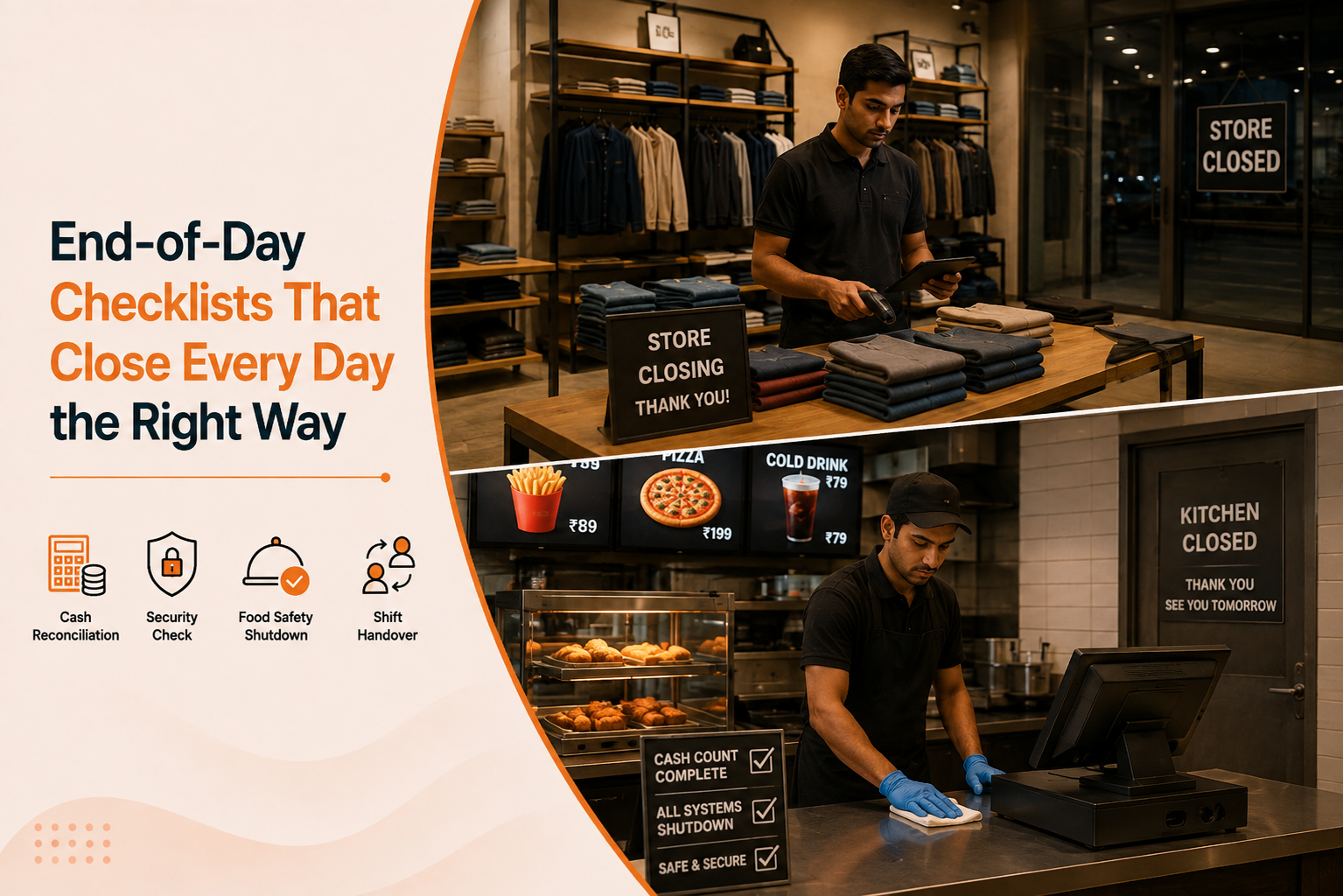
Retail Store and QSR Closing Checklist: Complete Guide
Read more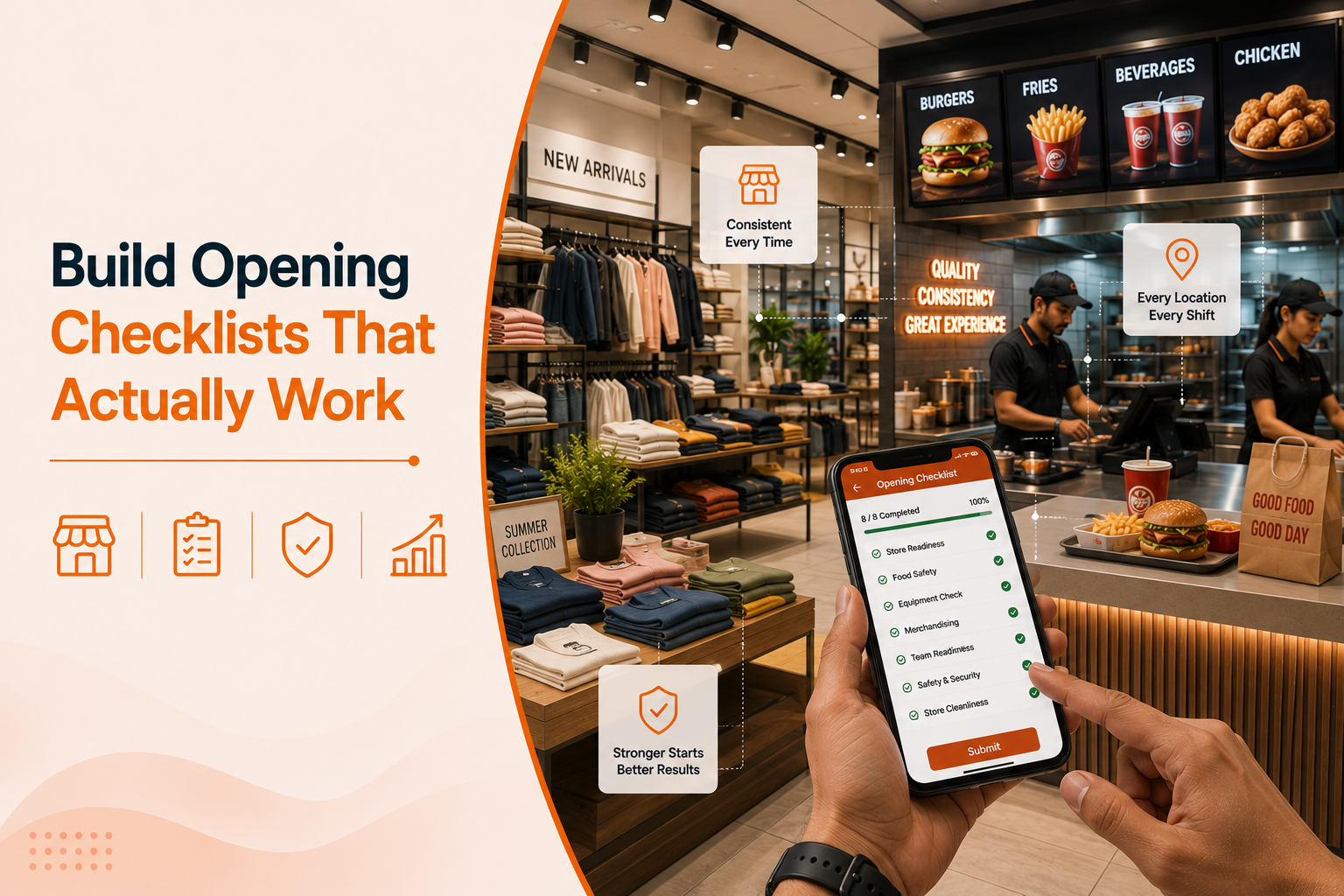
How to Open a Retail Store or QSR : A Step-by-Step Opening Checklist Guide
Why most opening checklists fail before the first mistake even happens, and how to build one that actually holds up across every shift and l…
Read more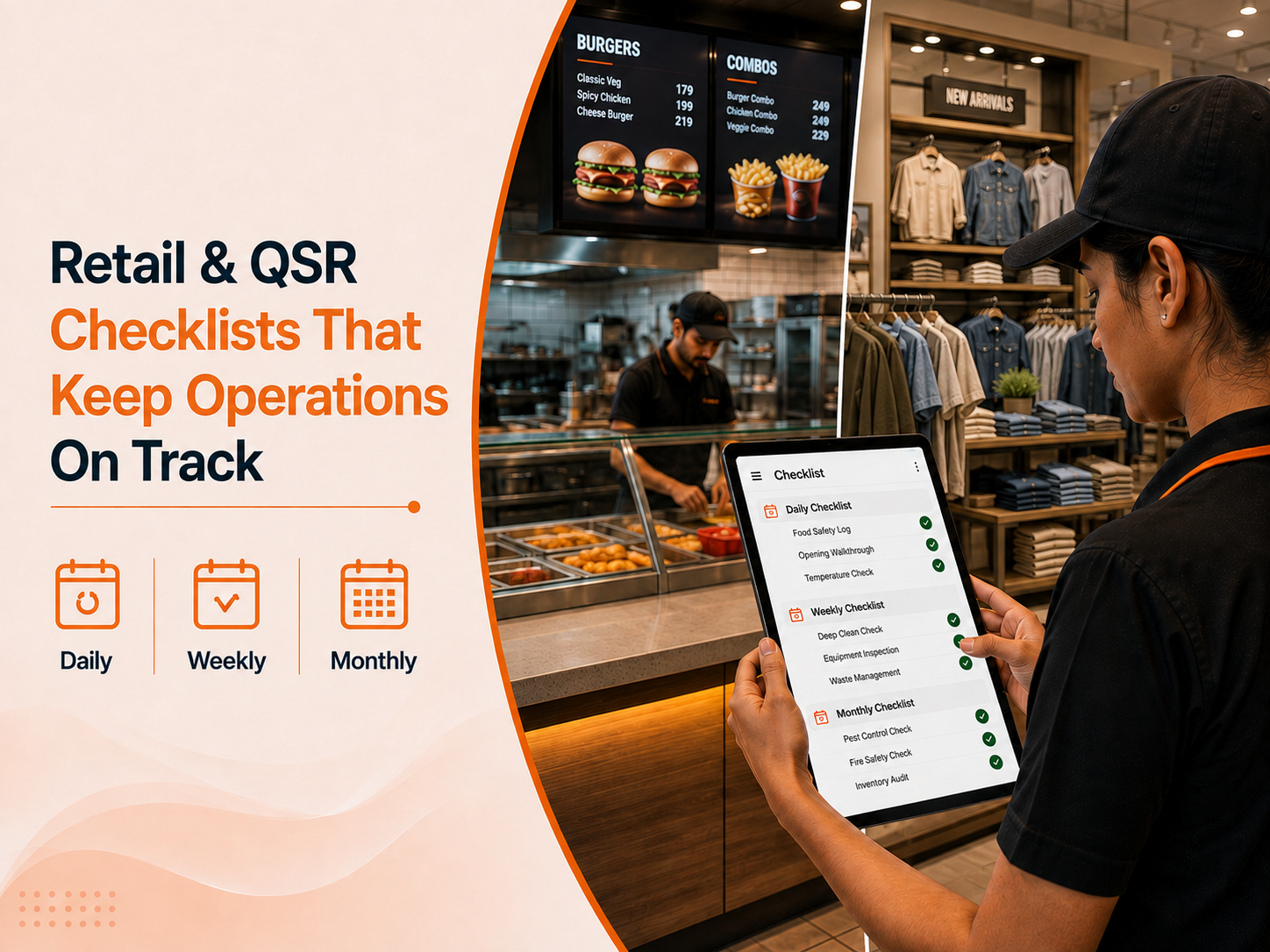
Types of Checklists Every Retail and QSR Store Needs
A detailed breakdown of daily, weekly, and monthly checklists for retail and QSR stores, including food safety logs, walkthroughs, and mobil…
Read more