

Festive Season Readiness Checklist for Retail Stores
Prepare your retail stores for festive season with a checklist covering pricing accuracy, stock readiness, billing, staffing, crowd safety, and store operations.
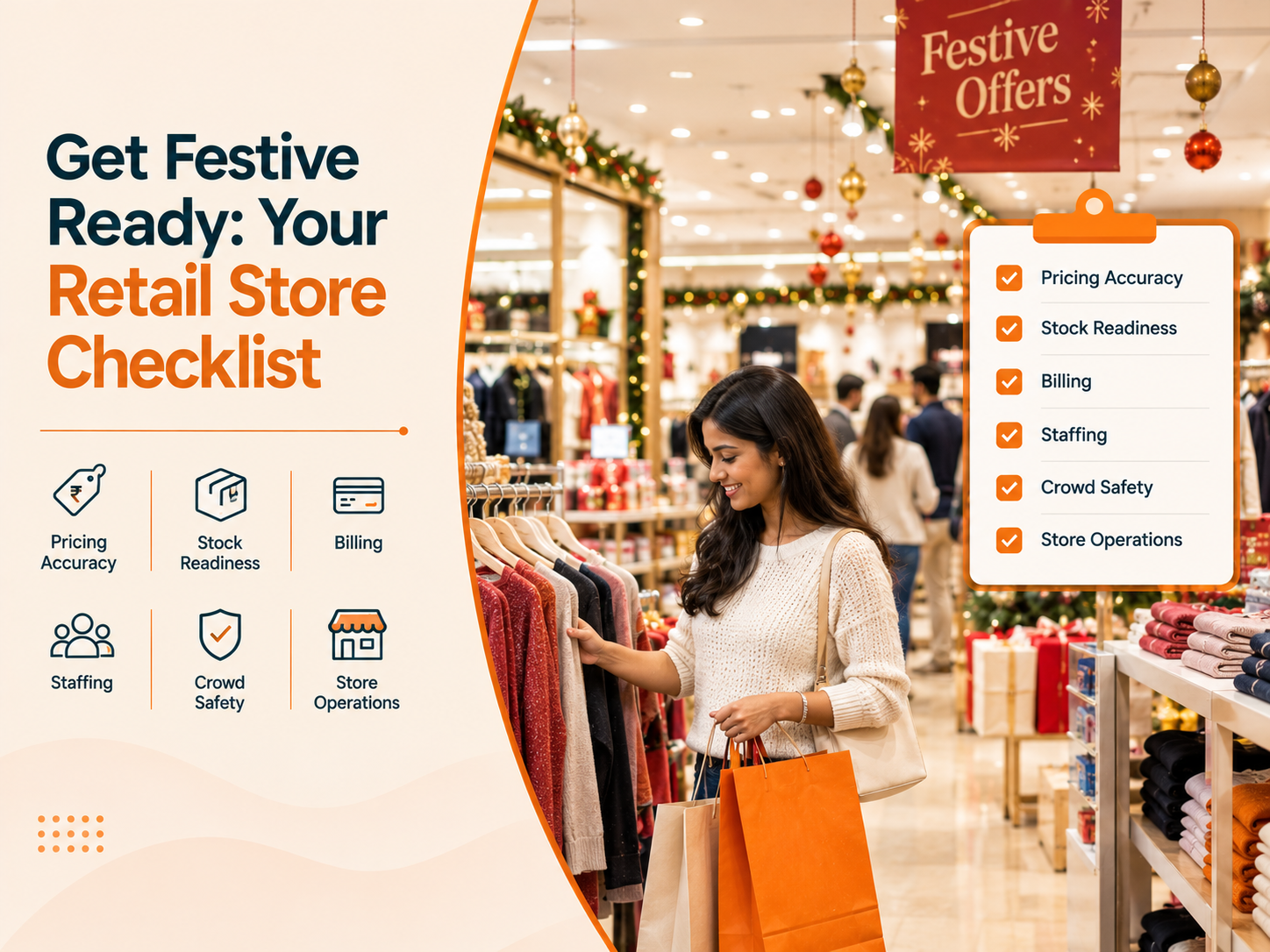
Every festive season, retail brands put most of their energy into the visible things: the campaign, the offers, the window display. Then the rush arrives, and the problems that cost the most turn out to be small ones. A shelf price that doesn't match the bill. A fast-selling item sitting in the backroom while the shelf is empty. One billing counter short of staff at 7 PM on Dhanteras. A good festive season checklist for retail stores is built around exactly these small things.
The Confederation of All India Traders (CAIT) reported Diwali 2025 trade of Rs 6.05 lakh crore, made up of Rs 5.40 lakh crore in goods and Rs 65,000 crore in services, which it described as the highest ever. A season this large is also where small gaps get expensive, because every one of them is multiplied by footfall.
This guide covers how festive shopping has changed, what that now demands from retail brands, and the checks that decide whether a store turns the rush into revenue.
Festive readiness at a glance
- Pricing and offers match on the shelf, at billing and online
- Top festive items are in stock, on the floor and in the backroom
- Displays are up early and never block aisles or exits
- Every billing counter and payment mode is tested before opening
- Staffing is planned by zone, not just by headcount
- Crowd, safety and security roles are defined in advance
- Returns and reset are planned for after the rush
How Festive Shopping Has Changed Over the Years
For earlier generations, festive shopping followed tradition and the calendar. Dhanteras, the first day of Diwali, is traditionally associated with buying gold, jewellery, utensils, appliances and even vehicles, and many households saved up for big purchases across the Diwali period. Most of that buying happened in person, over a small number of days, at familiar local stores.
The festival is the same. The way people shop for it is not:
- The season got longer. Unicommerce's analysis of more than 210 million festive transactions found that the sale period grew from just over a week in 2022 to a month-long shopping cycle.
- Smaller cities carry as much weight as metros. In the same analysis, tier 2 and tier 3 towns accounted for about 53% of festive orders in 2024.
- Paying got effortless. UPI apps and QR codes removed most of the friction at the till, and payments industry commentators say lower friction has led to more impulse purchases.
- Speed set a new bar. A report by LS Digital found that quick commerce grew 120% year on year during peak periods, and that roughly a quarter of urban consumers now follow journeys that mix online and offline.
- The store still matters. CAIT's Diwali 2025 report attributes 85% of trade to traditional and non-corporate retail, with rural and semi-urban India contributing 28%.
The festival did not shrink. It got longer, faster and more compared. A shopper walking into a store today has often checked the price on an app, expects the item to be in stock, and has less patience for a queue than their parents did.
What Festive Shoppers Expect from Retail Stores Today
Those shifts translate into a short list of expectations that every store, in every city, is now measured against:
- The price on the shelf is the price on the bill, and it matches what they saw online
- The item they came for is actually on the shelf
- Billing is quick, and any payment mode works
- Someone is available in the zone where they need help
- The store is clean, easy to move through, and safe
Brands raise their game here not by spending more, but by executing these basics identically across every store, every day, for the whole season. A longer season is a longer test.
Why Basic Store Checks Matter During Festive Season
The failures that cost the most during festivals are rarely dramatic. They are ordinary, and shoppers react to them quickly:
- Stock-outs send shoppers elsewhere. IGD research with 1,000 UK shoppers found that 37% would go to another store when an item is out of stock, and 19% would switch to a rival brand.
- Queues cost sales. A survey of 2,500 US shoppers by a checkout technology vendor found that 30% would leave without buying if there were three people ahead of them, rising to 65% at five. The same survey found 22% would never return after a single bad experience.
Both studies come from other markets, but the behaviour behind them is familiar to any store manager. Footfall is the expensive part of festive season, because brands pay for it through campaigns, discounts and decoration. A stock-out or a slow queue sends that footfall to the next shop on the street.
Two things make the basics harder this year. First, staffing: Adecco India expects temporary staffing demand to rise 15 to 20% in the 2026 festive season, and about 80% of employers report shortages in frontline and operational roles. That means more first-timers running the floor, and basics that live in people's memory rather than in a written process will not survive the rush. Second, scale: a check missed in one store is a complaint, but missed across forty stores it becomes a pattern that customers talk about.
Pricing and Offer Accuracy Checks
Pricing mismatches are among the quickest ways to turn a festive offer into a complaint.
- Shelf tags, POS prices and app or online prices match for every festive offer
- Offer start and end dates and times are set identically in every store
- Old tags and expired promotions are removed
- Combo and bundle rules are tested at the billing counter, not just configured in the system
- Staff can explain each offer in one sentence
Picture a shopper who picks up a festive-priced item, only to see the old price on the bill. Billing stops while someone calls a manager, and the queue behind them grows. One mismatch costs a sale, the customer's trust, and a minute for every person waiting. The fix is simple: one named owner per store checks a sample of offer items from shelf to bill before opening on day one, and again whenever offers change.
Stock Readiness: Shop Floor and Backroom
Festive demand concentrates on a handful of categories, such as gifting, apparel, electronics, home décor and festive food. Stock readiness means knowing which items matter most and being able to restock them quickly.
- Identify the top festive items per store and set restock triggers for each
- Organise the backroom by category, with fast movers nearest the door
- Spot-check shelf and backroom counts of top items before the first big weekend
- Keep system counts accurate, since online and pickup orders draw from the same stock
Consider a gifting display that is empty by 11 AM on a Saturday while the stock sits behind unopened cartons of slow-moving items in the back. The customer sees an out-of-stock shelf. The real failure is the backroom. Our guide to every section of a retail store explains why replenishment speed is decided there.
Store Display and Visual Merchandising Checks
Festive displays are one of the few places where preparation is visible to customers, but they also carry safety risk.
- Put displays up before the first big weekend, not during it
- Place signage at eye level without blocking sightlines or aisles
- Check lighting and electrical decorations for loose wires and overloaded sockets
- Keep aisles and emergency exits clear of décor, boxes and display extensions
- Share a reference photo with every store so displays match the brand standard
A decorative stand placed near the entrance for a photo moment can narrow the walkway just enough to create a bottleneck on a busy evening. Displays should be judged on how the store moves with a full crowd, not how it looks when empty.
Billing, POS and Payment Readiness
Most festive purchases end at the billing counter, so a counter that is slow or down undoes everything before it.
- Run a test transaction on every counter before opening, using a festive-offer item and each payment mode (UPI, cards, wallets)
- Document a fallback if the payment network or POS goes down, such as a spare terminal or a manual billing process
- Stock bill paper, bags, gift wrap and tags at every counter
- Decide in advance when a second and third counter open, based on queue length rather than the clock
- Display gift receipt and return policies clearly, since gifting increases returns
With QR and UPI now the default for many shoppers, a code that doesn't scan or a network that drops is a stopped sale.
Staffing and Shift Coverage by Zone
A store can look fully staffed on paper and still be thin at the counter at the busiest hour. Plan coverage by zone, not just by headcount.
- Set minimum coverage for each zone: entrance and floor, fitting rooms, billing, backroom
- Cross-train staff so someone can move between billing, floor and stock during a rush
- Confirm critical shifts in writing, such as festival eve and weekends, instead of assuming a published roster is enough
- Teach seasonal hires the handful of tasks they will do most often first, such as billing, offer rules, returns, where things are, and who to call when something goes wrong
- Plan breaks and rest, because tired teams make more errors in the third week of a month-long season
Our 10 workforce scheduling best practices cover the wider principles behind building rosters that hold up under pressure.
Crowd, Safety and Security Checks
More people in the store means more that can go wrong, and less time to figure out who decides what.
- Assign a staff member to manage the entrance during peak hours, with one-way flow where needed
- Keep emergency exits unobstructed and extinguishers accessible, and use flame-safe décor
- Define who can restrict entry, call security or escalate a crowd or safety issue, so the decision is not made on the spot. Our guide to building an incident escalation matrix covers how to structure this
- Give extra attention to fitting rooms, crowded aisles and checkouts, where shrinkage is hardest to spot
- Confirm cameras are working and not blocked by new décor before the season starts
For brands with many stores, AI Video Analytics on existing store cameras gives head office a live view of footfall and crowd patterns, so a store that is filling up faster than planned does not go unnoticed until someone calls.
Daily Festive Season Store Checklist
A festive checklist does not replace the daily one. It adds a few checks that matter more when the store is full. For the base routine, see our opening checklist guide and our breakdown of the types of checklists every retail and QSR store needs.
Before opening
- Alarm, exits, lighting and décor safety walk
- Sample offer items checked from shelf to bill
- Test transaction on each counter and payment mode
- Shelf and backroom counts of the top festive items
- Zone assignments and a short briefing on today's offers and expected peak hours
Mid-day
- Restock top sellers before they reach zero
- Check queue length and open counters accordingly
- Check fitting rooms and the returns area
- Walk the floor for blocked aisles and exits
At closing
- Reconcile cash, card and UPI totals
- Record stock-outs and tomorrow's replenishment needs
- Remove expired offers and set up the next day's
- Write handover notes for the opening team
After the Festive Rush: Returns and Reset
The week after the peak is often under-planned. Gift returns and exchanges rise, stock counts drift, and teams are tired.
- Assign dedicated staff or a counter for returns
- Reconcile stock and update system counts
- Reset displays and remove festive pricing everywhere
- Record which offers, hours and zones were under pressure, so next year's plan starts from real data
- Give the team time to recover before the next season begins
Keeping Every Store on the Same Page
Everything above is straightforward in one store. Across many stores for a month, the challenge is proving it was done, and knowing quickly where it wasn't.
With NymbleUp's Task & Audit checklists, store teams complete festive checks on their phones, with time stamps and photo proof, and head office can see which stores are on track without chasing calls. Workforce Scheduling helps align rosters to expected festive demand using footfall, sales history and seasonality, rather than a flat roster for every day of the season.
Book a personalized demo to see how NymbleUp helps retail brands keep every store festive-ready.
FAQ
What should a retail store do before festive season? Verify pricing and offers from shelf to bill, build stock of top festive items and organise the backroom for fast restocking, test every billing counter and payment mode, set zone-based staffing, and confirm safety and security checks, including exits, décor and cameras.
How early should festive season preparation start? Earlier than the first visible rush, and in a set order. With festive sale periods now stretching to roughly a month, start with hiring and training seasonal staff, then lock offers, pricing and stock plans, then put displays up. Billing and payment tests, and the shelf-to-bill price check, come last, right before the first big weekend, so they reflect the final setup.
How do stores avoid pricing mismatches during festive sales? By checking a sample of offer items from shelf to POS to app before opening, setting offer dates and times identically across stores, removing old tags, and assigning one named owner per store to repeat the check whenever offers change.
Is a festive checklist different from a daily store checklist? It builds on the daily one. The core opening, mid-day and closing routines stay, with added checks on offer accuracy, top-item stock, payment readiness, crowd flow and safety that matter more when footfall is high.
Retail Store and QSR Closing Checklist: Complete Guide
Read more
How to Open a Retail Store or QSR : A Step-by-Step Opening Checklist Guide
Why most opening checklists fail before the first mistake even happens, and how to build one that actually holds up across every shift and l…
Read more
Types of Checklists Every Retail and QSR Store Needs
A detailed breakdown of daily, weekly, and monthly checklists for retail and QSR stores, including food safety logs, walkthroughs, and mobil…
Read more