

How to Build an Incident Escalation Matrix for Multi-Location QSR Brands
Learn how to build a restaurant incident escalation matrix, from severity levels to notification hierarchies, for faster multi-location response.
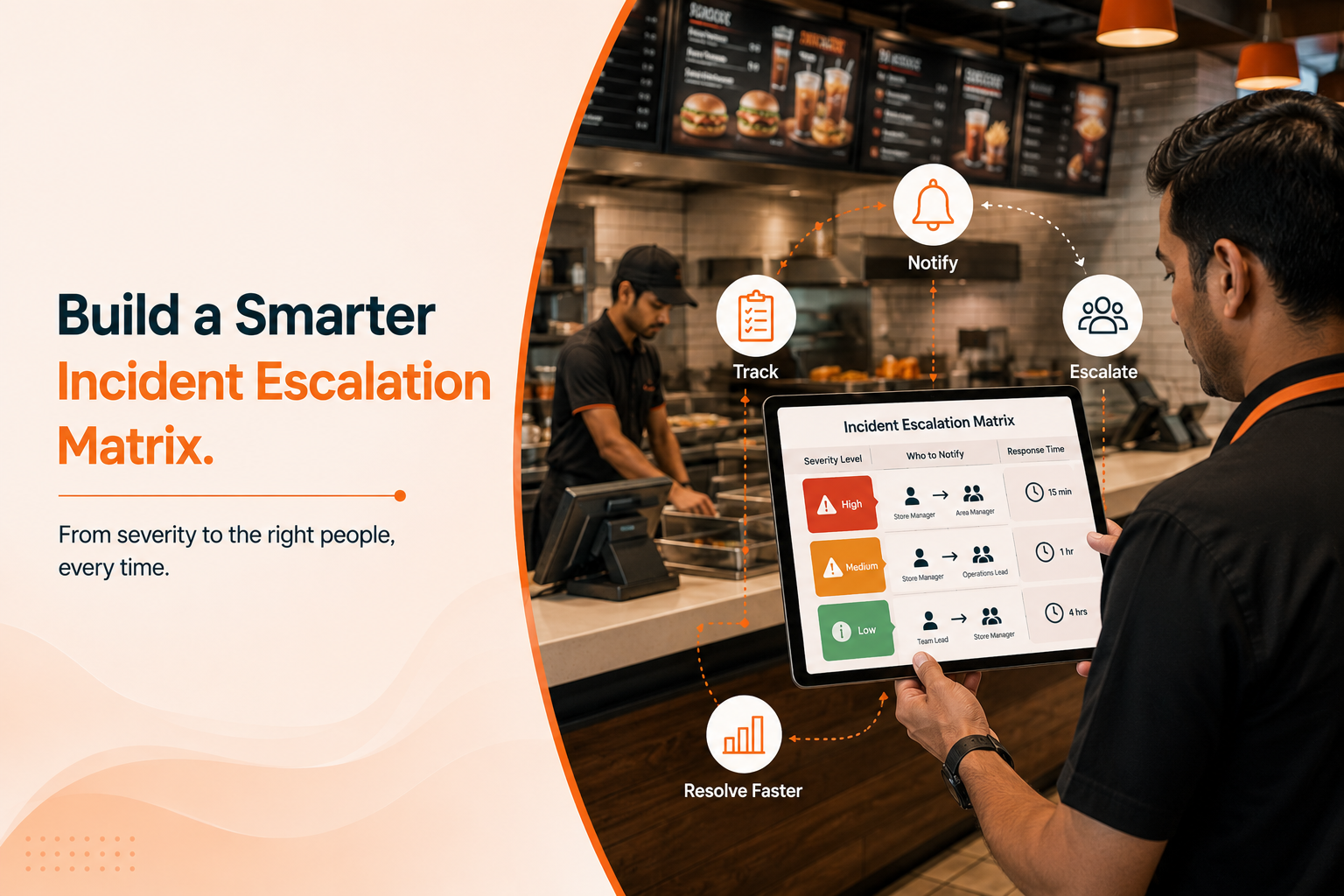
Every restaurant deals with operational incidents: a refrigeration unit failing mid-shift, a customer food safety complaint, a POS outage, an employee injury. The incident itself is often unavoidable. What determines its impact is how quickly and consistently your team responds.
In many growing QSR brands, escalation still depends on phone calls, WhatsApp messages, or individual judgement, so one manager escalates immediately while another waits until end of shift. As the business expands, these inconsistencies create delays, reduce visibility, and increase operational risk.
An incident escalation matrix removes this uncertainty. It's a structured process for reporting, escalating, and resolving incidents across every outlet, giving every location the same playbook and building a foundation for consistent restaurant incident management. Instead of relying on memory, every employee knows what to do, who to inform, and how quickly to act.
Why Every Multi-Location QSR Needs an Incident Escalation Matrix
Managing incidents across five restaurants is very different from managing them across fifty or five hundred. As operations grow, maintaining consistency becomes increasingly difficult. Without a standardized escalation process, businesses often face:
- Critical incidents reaching senior teams too late
- Different outlets following different reporting processes
- Managers unsure whom to notify
- Delays caused by phone calls or messaging apps
- No visibility into whether an incident has actually been resolved
- Limited accountability once an incident is reported
These gaps don't happen because employees aren't trying. They happen because there's no standardized framework guiding the response. An incident escalation matrix fixes that by ensuring every location follows the same process, creating faster communication, better accountability, and greater operational consistency.
What Is an Incident Escalation Matrix?
An incident escalation matrix is a structured framework that defines how different types of incidents should be managed. Rather than leaving decisions to individual employees, it answers five questions in advance:
- What type of incident has occurred?
- How serious is the incident?
- Who should be informed?
- How quickly should they be informed?
- Who is responsible for resolving it?
When these are decided ahead of time, restaurant teams spend less time deciding what to do and more time resolving the issue, creating a consistent incident management process across every restaurant.
Step 1: Identify the Types of Incidents
Not every incident should follow the same escalation process. A customer complaint and a suspected food contamination issue require different levels of urgency and different stakeholders. Start by grouping incidents into categories that reflect your day-to-day operations:
Food Safety Food contamination, temperature deviations, expired products, allergen concerns, hygiene violations, or pest sightings. These usually require immediate attention because they directly impact customer safety and QSR safety compliance.
Customer Incidents Customer injuries, serious complaints, property damage, disputes, or situations that may affect the brand's reputation.
Equipment and Maintenance Kitchen equipment failures, refrigeration breakdowns, utility outages, POS issues, HVAC failures, or maintenance-related disruptions that affect service speed and operational continuity.
Employee Safety Workplace injuries, fire hazards, unsafe working conditions, or any incident that places employees at risk.
Security and Cash Management Cash discrepancies, theft, unauthorized access, vandalism, suspicious activity, or security breaches.
Operational Issues Stock shortages, supplier delays, housekeeping concerns, cleaning issues, staffing shortages, or any operational challenge that impacts daily performance.
Categorizing incidents this way ensures similar situations are handled consistently across every outlet.
Step 2: Define Severity Levels
After identifying incident types, determine how serious each one is. Not every issue needs senior leadership involved, and a minor housekeeping issue shouldn't trigger the same response as a customer injury or food safety incident. A simple four-level framework works well for most QSR brands:
Low
- Example: Minor cleaning issue or non-critical maintenance request
- Response: Managed by the restaurant team and monitored until closure
Medium
- Example: Equipment malfunction affecting operations or repeated customer complaints
- Response: Escalated to the area manager for timely resolution
High
- Example: Customer injury, major equipment failure, or significant service disruption
- Response: Immediate escalation to regional operations with continuous updates
Critical
- Example: Food contamination, fire, gas leak, or major safety incident
- Response: Immediate notification to senior leadership and rapid response per emergency protocols
Clearly defining severity levels helps teams understand the urgency, expected response time, level of management involvement, escalation path, and documentation required before closing an incident.
Combining incident categories with severity levels creates the foundation of an effective escalation matrix. Next: deciding exactly who gets notified, and how fast.
Step 3: Decide Who Should Be Notified
One of the most common mistakes QSR brands make is notifying either too many people or too few. Every incident should be recorded, but not every incident needs to reach senior leadership. A simple notification hierarchy keeps escalation proportional to severity:
- Low: Restaurant Manager
- Medium: Restaurant Manager, Area Manager
- High: Restaurant Manager, Area Manager, Regional Operations Manager
- Critical: Restaurant Manager, Area Manager, Regional Operations Manager, Operations Head, Leadership Team (if required)
Defining this in advance means everyone understands their role before an incident occurs, reducing confusion during high-pressure situations.
Step 4: Define Response Timelines
Knowing who to notify is only part of the process. Your matrix also needs to define how quickly each incident requires attention, or incidents stay open simply because no urgency was established:
- Low: Within the same shift
- Medium: Within 1 hour
- High: Within 15–30 minutes
- Critical: Immediate
These timelines should reflect your operational requirements and regulatory obligations. The goal isn't just speed, it's making sure every outlet follows the same expectations regardless of location.
Step 5: Define Ownership and Required Actions
Every incident needs a clear owner. Without one, incidents move from person to person without anyone taking responsibility for resolution. For each incident type, define:
- Who reports the incident
- Who acknowledges it
- Who investigates it
- Who approves the resolution
- Who closes the incident
It also helps to specify what's required before an incident can be marked resolved:
- Uploading photographs or supporting evidence
- Recording the root cause
- Assigning corrective actions
- Verifying the issue has been resolved
- Documenting preventive measures to reduce recurrence
This structure improves accountability and builds a complete record for future reviews and audits, which matters most once you're running multi-unit incident reporting across dozens or hundreds of outlets.
Common Mistakes to Avoid
Even with a matrix in place, a few habits can quietly undermine it:
- Treating every incident with the same level of urgency
- Leaving ownership for investigation or resolution unclear
- Depending on WhatsApp messages or phone calls for critical escalations
- Defining response timelines but not monitoring whether they're met
- Closing incidents without documenting corrective actions
- Reviewing incidents individually instead of analysing recurring trends across locations
Regularly reviewing your escalation process helps it keep pace with a growing restaurant network.
Example of a Simple Incident Escalation Matrix
The matrix doesn't need to be complicated, just consistent. Here's how it comes together across four common incident types:
Food Safety Issue
- Severity: Critical
- Notify: Restaurant Manager, Area Manager, Operations Head
- Response Time: Immediate
- Primary Owner: Restaurant Manager
Customer Injury
- Severity: High
- Notify: Restaurant Manager, Area Manager
- Response Time: Within 15–30 minutes
- Primary Owner: Restaurant Manager
Equipment Breakdown
- Severity: Medium
- Notify: Restaurant Manager, Area Manager
- Response Time: Within 1 hour
- Primary Owner: Restaurant Manager
Stock Shortage
- Severity: Low
- Notify: Restaurant Manager
- Response Time: Same shift
- Primary Owner: Shift Manager
As your business grows, this matrix can become more detailed with additional incident categories, departments, escalation levels, and service-level agreements (SLAs). The key is keeping it simple enough that every employee understands and follows it consistently.
Conclusion
Incidents are an inevitable part of restaurant operations. What separates high-performing QSR brands isn't the absence of incidents, it's the consistency of their response.
A well-designed incident escalation matrix removes uncertainty by defining who needs to be informed, how quickly they should respond, and who owns resolution. For multi-location brands, that means faster communication, stronger accountability, and greater operational consistency across every outlet. As your business expands, standardising incident escalation becomes just as important as standardising food quality or service, and it's a core part of any serious restaurant safety compliance program.
Standardize Incident Management Across Every Outlet
Creating an incident escalation matrix is the first step. Making sure every restaurant follows it consistently is the next.
With NymbleUp Incident Management, restaurant brands can digitize incident reporting, automatically notify the right stakeholders based on severity, track resolution progress in real time, and maintain complete visibility across every location.
Book a personalized demo to see how NymbleUp helps multi-location QSR brands respond faster and manage incidents more efficiently.
Incident Management in QSR: Why Response Speed Now Determines Brand Reputation
QSR incidents now go public before they're reported internally. Here's how incident management systems close that gap and protect brand repu…
Read more
Why WhatsApp Is Not an Incident Management System
WhatsApp is great for communication, but it lacks the accountability, tracking, and visibility required to manage operational incidents effe…
Read more