

How to Open a Retail Store or QSR : A Step-by-Step Opening Checklist Guide
Why most opening checklists fail before the first mistake even happens, and how to build one that actually holds up across every shift and location.
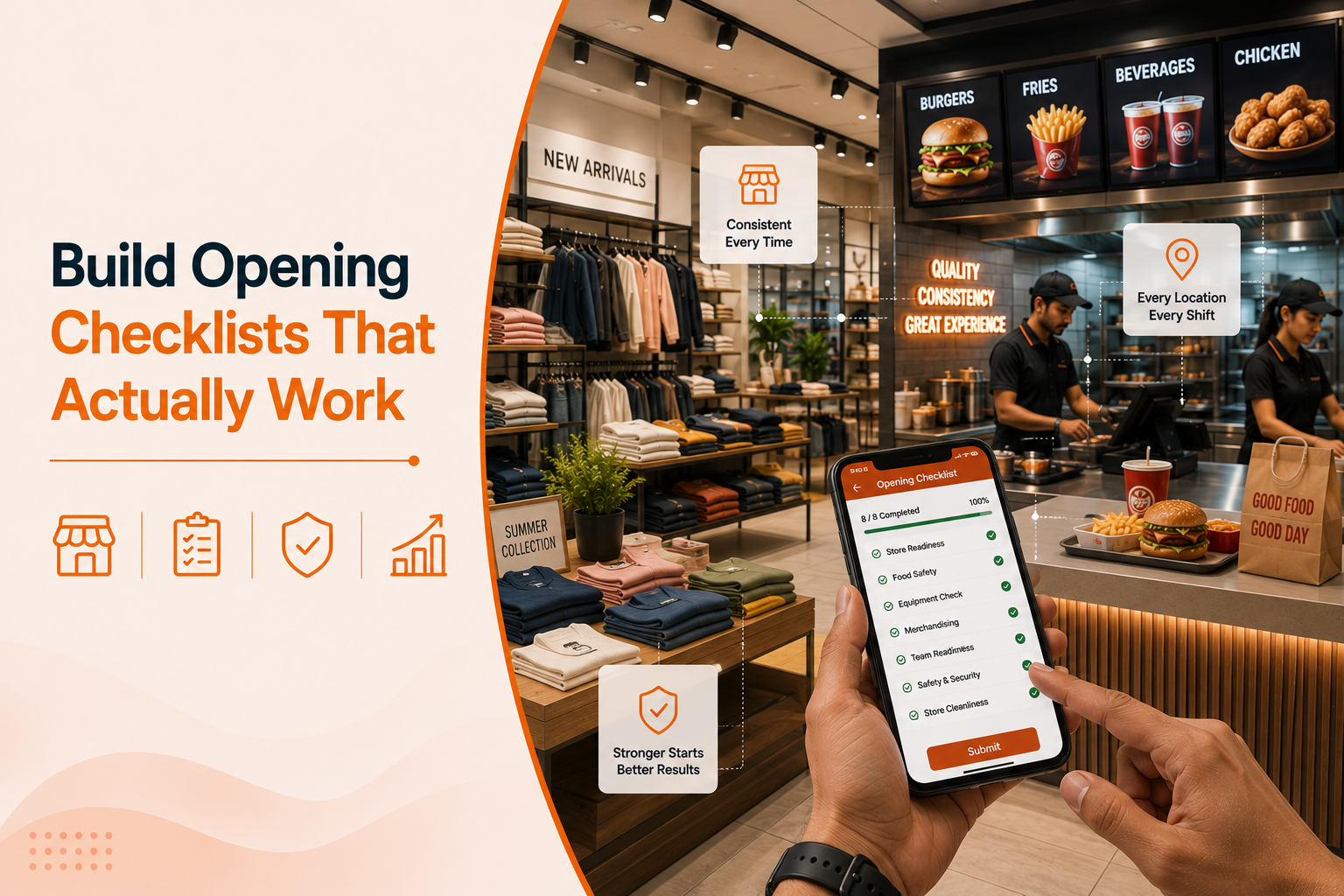
Ask most managers what went wrong on a bad morning, and the answer is rarely "we forgot to check something." It's usually something closer to: nobody was sure whose job it was, or nobody knew what to do once something was actually found to be wrong. The tasks were known. The ownership and the response weren't.
That distinction matters more than most opening checklists admit. Restaurant service research cited across the industry points to just how expensive small opening-hour inconsistencies become downstream, a single wrong order takes 15 to 20 minutes to fix once a guest is already at the table, and a large majority of diners will simply try a competitor after repeated mistakes. Operations that run on structured, well-owned procedures rather than informal habits have been shown, in industry studies, to cut service errors by as much as a fifth. The opening hour is where that gap between "structured" and "informal" gets decided, before a single customer walks in.
This guide covers what actually needs to happen when opening a retail or QSR store, and more importantly, who owns each part and what happens when something isn't right. It's one part of a broader system, if you haven't already, it's worth starting with our guide to types of checklists every store needs and our complete guide to Standard Operating Procedures, since an opening checklist is really just one SOP in daily practice. The core flow covered here is largely the same across retail and food service, only the specifics differ.
Why Opening Checklists Fail Even When Every Task Is Listed
Most stores already have some version of an opening list. What they're usually missing is three things attached to each task: who's responsible, how "done" is actually verified, and what happens if it isn't.
This is where informal opening routines quietly fail, especially in multi-location operations:
- Different shifts and different staff develop their own version of "how we open," and those versions drift apart over time without anyone deciding to change anything
- When a task's owner isn't explicitly assigned, it either gets done twice by two people who each assumed it was theirs, or skipped entirely because each person assumed someone else had it
- A checklist that only records "done" gives no way to catch a problem before it reaches a customer, verification has to be built into the task itself, not assumed afterward
A genuinely useful opening procedure isn't a list of chores. It's a sequence of checkpoints, each with an owner and a defined "what if this fails" response.
Security and Safety Checks
Nothing else on the list should happen until this step is done. Whoever opens the store should:
- Disarm the alarm using the correct code or fob
- If the alarm fails to disarm, retreat to a safe location immediately and call the manager and the security provider, not investigate alone
- Walk the space for anything unusual left from overnight: leaks, damage, signs of forced entry, anything out of place
- Confirm emergency exits are clear and exit signage is functioning
This step exists for a reason most checklists don't spell out: everything that follows assumes the space is safe to be in. Skipping straight to equipment or cash setup without this check means building the rest of the morning on an unverified assumption.
Equipment and Systems Checks
Equipment that takes time to warm up should start early, while other tasks continue around it, not be left until everything else is done.
For point-of-sale and payment systems, this covers:
- Switching on lights and starting POS terminals
- Testing payment terminals and card readers, including a quick check for tampering, skimming devices are more often installed on unattended terminals overnight than most managers assume
- Powering on and testing barcode scanners and receipt printers
- Running a test transaction before the first real one, catching a broken payment flow before a customer does is far better than catching it during a queue
For kitchen equipment, this covers:
- Starting ovens, grills, and fryers early enough to reach operating temperature without holding up the rest of the sequence
- Switching on hoods and ventilation
- Checking refrigeration units held temperature overnight, before any prep work begins
Cash Handling and Food Safety Checks
These two checks tend to happen in parallel, since delaying one to finish the other creates its own risk.
Cash setup means counting the starting float, checking it against the previous day's closing count, and logging that count before it goes into the register. If a discrepancy shows up, many operations use a set threshold, a small, fixed amount, past which a recount and documented explanation become mandatory before the drawer is finalized. That record is what makes a shortfall traceable later instead of just a mystery.
Product and food safety checks, particularly in QSR, need to happen as more than one check, not a single glance at a fridge:
- Walk-in coolers, hot-holding units, and any pre-cooked or prepped items each have a different safe range and need to be logged separately
- Stock rotation gets verified, confirming FIFO (first-in, first-out) is actually being followed, and that items are dated correctly
- Sanitizer concentration at prep and wash stations gets checked before service prep begins in earnest
The part most basic checklists leave out entirely: what happens when a reading fails. The correct response is to isolate the affected item immediately, document the actual reading, and notify whoever is responsible for food safety decisions, before that item goes anywhere near service. A temperature log without a defined next action isn't protecting anyone, it's just a paper trail of a problem nobody acted on.
Store Readiness and Cleanliness Checks
A handful of areas tend to have outsized impact on a customer's first impression, and are worth checking in this order:
- The entrance and storefront, since it's what pulls someone in before they've even stepped inside
- The checkout or service counter, fully stocked and ready for a smooth first transaction
- The main aisle, display, or service line, merchandised or stocked and complete
- Fitting rooms, restrooms, or the dining area, clean and cleared from the night before
- Back stock or storage access, clear and organized, since a blocked stockroom or prep area slows down the entire day, not just the opening
For food service specifically, takeout and drive-thru stations get set up with packaging and condiments ready to go, and the service line gets stocked and sanitized. Lighting, signage, and music go on here too, in both formats, this is the layer that makes a space feel ready rather than just functional.
Final Walkthrough and Manager Sign-Off
The final step isn't re-checking everything already done. It's a short, deliberate walkthrough confirming the store genuinely looks and feels ready, followed by a sign-off.
That sign-off matters more than it looks like it should. A record of who completed the opening, and when, is what makes the entire process accountable after the fact. If a complaint comes in, a discrepancy shows up, or an inspector asks questions, that sign-off is the difference between "the process was followed" and "we assume it probably was."
What to Prioritize When Running Behind Schedule
Some mornings won't go to plan. When they don't, the order of what matters stays fixed:
- Security and safety checks are never skipped, regardless of time pressure
- Food and product safety checks come next, since compromising there creates real risk, not just inconvenience
- Customer-facing presentation is the layer that can be compressed or finished just after doors open, if it genuinely comes down to that
Deciding this order in advance, rather than improvising under pressure, is what keeps a rushed morning from becoming a genuinely risky one.
Benefits of a Digital Opening Checklist
A paper version of this process can confirm a task happened. It's far weaker at confirming when it happened, in what order, or whether it happened within the time it was supposed to. Everything comes down to trusting that whoever filled it in was accurate about timing, which is nearly impossible to verify after the fact.
A digital checklist changes this in three specific ways:
- It becomes time-bound, not just task-bound. Each step gets timestamped the moment it's marked complete, not filled in retroactively at the end of a shift. A manager reviewing the record later can see whether the actual sequence was followed, not just whether every box eventually got ticked.
- Photo proof replaces trust with evidence. A temperature reading typed in as a number is easy to enter without checking. A photo of the thermometer attached to that same entry is far harder to fake. The same applies to a stocked checkout counter or a display matching the current plan, a photo turns "I checked" into something a manager can verify without being on-site.
- Reporting stops depending on someone chasing paperwork. Across ten or fifty locations, seeing how this morning's opening went on paper means physically collecting or requesting each form, if it happens at all. Digitally, that same view, completion, timing, and anything flagged, is available immediately across every store from a single dashboard.
Opening is only half of the daily cycle, closing carries its own set of risks and its own checklist logic. Read our closing checklist guide for retail and QSR stores to complete the picture.
Book a personalized demo to see how NymbleUp helps teams run a consistent, time-stamped, photo-verified opening checklist across every store.
FAQ
What's the correct order for opening a retail store or restaurant? Security and safe entry come first, followed by bringing equipment and systems online, then cash and safety checks in parallel, then customer-facing readiness, ending with a final walkthrough and sign-off.
What should you do if the alarm doesn't disarm properly? Retreat to a safe location immediately and call the manager and the security provider. Investigating alone isn't the correct response.
What should you cut first if you're running out of time before opening? Customer-facing presentation tasks, cleaning, displays, signage, are the ones that can reasonably be compressed or finished just after doors open. Security and safety checks should never be the ones cut.
What should happen if a temperature check fails during opening? The affected item should be isolated immediately, the reading documented, and the manager or person responsible for food safety decisions notified before that item is used in service.
Why do opening checklists fail even when every task is listed? Usually because ownership and escalation aren't built into the checklist itself. A task with no assigned owner gets duplicated or skipped, and a check with no defined "what if this fails" response doesn't actually catch problems before they reach a customer.
Retail Store and QSR Closing Checklist: Complete Guide
Read more
Types of Checklists Every Retail and QSR Store Needs
A detailed breakdown of daily, weekly, and monthly checklists for retail and QSR stores, including food safety logs, walkthroughs, and mobil…
Read more
Standard Operating Procedures (SOPs): A Complete Guide for Multi-Location Businesses
Learn what SOPs are, why they matter for multi-location retail, QSR, and hospitality brands, and how to create, roll out, and maintain them …
Read more